
Cyclist Khaki
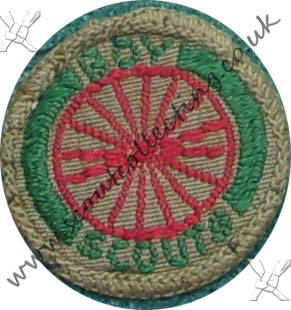
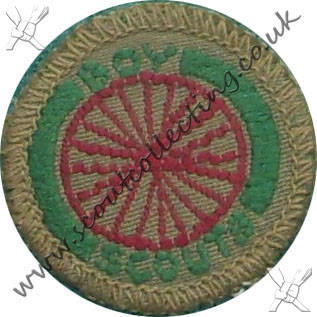
Cyclist Scout Badge Woven and Bound 1934 to 1967
The Cyclist was worn on the Right arm in between the shoulder and elbow.
The badge was changed to the Messenger in 1947
A scout could not gain any more than
6 proficiency badges before gaining a First Class scout badge.
To earn this badge a scout must do
the following *
(1) Demonstrate that he owns or has the use of, and
has used satisfactorily for at least six months, a cycle, properly equipped and
in good working order. He must be willing to use it in the Queen’s service if
called upon at any time in case of emergency.
(2)
Demonstrate that he can effect simple repairs which might the following at the
discretion of the Examiner: change tyre and tube, mend a puncture, replace a
brake, adjust a wheel bearing or any
part of the machine.
(3) Demonstrate that he knows the Highway Code,
traffic signals, lighting-up times, road signs, national system of road
numbering and is able to read a road map.
Note. A Scout who has passed the Cycling Proficiency Test of the Royal Society for the Prevention of
Accidents qualifies automatically for
part 3 of this badge.
(4) Repeat correctly a verbal message after a ride
of at least one hour’s duration or after two miles at Scout Pace. If a cycle is not available for use or
ownership, the following can be substituted for Sections 1 and 2 : Demonstrate
that he can observe, remember and report
verbally in the following circumstances :—witness an incident or occurrence or observe over an area for not
less than five minutes, and then walk or
run at Scout Pace for not less than
three miles. On arrival at the specified spot to which he is directed he
must report first verbally and then in writing, giving a full and complete
account of what he has witnessed or observed.
*The Requirements for each badge varied through issues of POR
 More badges...
 Top of page

